Some days I’m on top of the world.
Other days? I’m just trying to breathe through the weight of it all without screaming into a pillow or disappearing into the void.
Yeah—I’m not perfect.
But I’ve learned something sacred: I don’t have to be.
What I do need is a way to care for myself when I forget how.
That’s where my Emotional Safety Kitt comes in.
It’s my backup plan for the days that feel like too much,
for the nights when my thoughts won’t shut up,
for the moments when I need someone to take care of me—and that someone is me.
—
💡 So what’s an Emotional Safety Kitt?
It’s not magic. But damn, it feels close.
It’s a personalized collection of the things that help me feel safe, soothed, and steady when life pulls me under.
And because emotions don’t arrive in neat little packages, I use a 1–10 emotional check-in scale to guide myself.
You know those “How are you today?” charts from childhood?
Yeah—this is the grown-up, soul-healing version.
Because when I’m falling apart, I don’t want to think—I want to feel seen.
—
🌡️ My 1–10 Emotional Gauge (Real Talk Edition):
1–3: I’m chill. Life’s flowing. I’m okay.
4–5: I’m off. A little edgy. I need a breather.
6–7: I’m heavy. Sad. Overwhelmed.
8–10: I’m in shut-down, panic, or straight-up survival mode.
Instead of fighting how I feel, I match my state with a soothing tool that helps me return to myself—not to perform, not to fix—just to feel safe again.
—
🎒 Sample Tools from My Emotional Kitt:
🟢 When I’m calm (1–3):
Water my plants and hum to them
Journal the joy I’m grateful for
Read a good book under a soft blanket
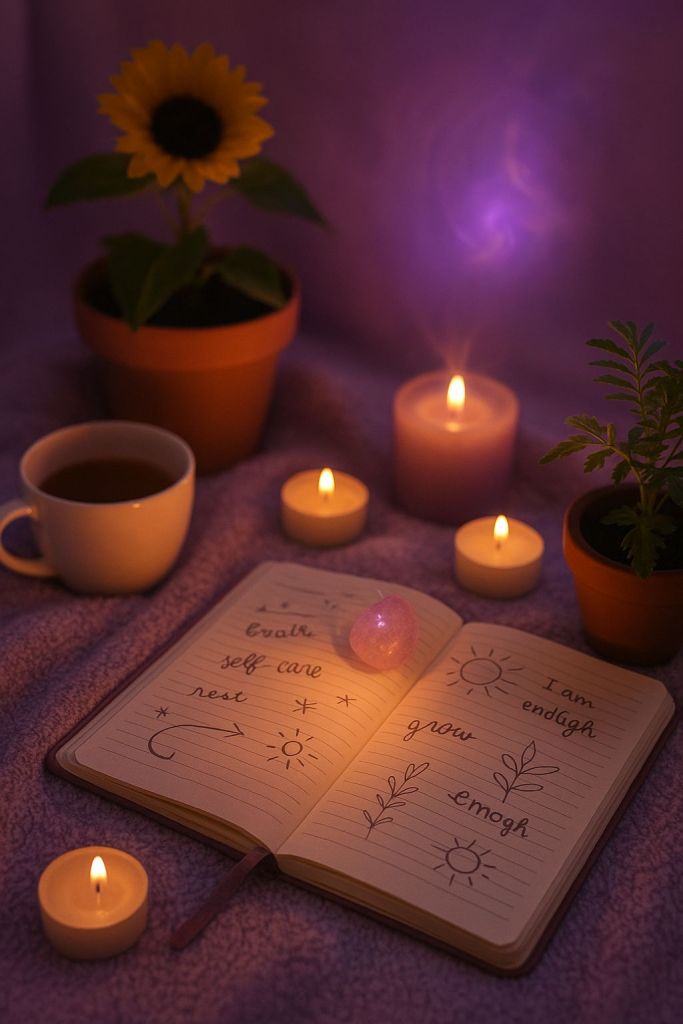
Light a candle and sip something warm
🟡 When I’m stressed or wired (4–5):
Go for a slow walk and notice five things around me
Do a quick coloring page while playing chill beats
Text a friend who gets it
Sort a drawer (weirdly calming, don’t ask)
🟠 When I’m sad or spiraling (6–7):
Take a tuning soak and let my playlist speak for me
Wrap up in my heated blanket and cry without apology
Paint with no goal—just feeling
Read comforting affirmations out loud until they land
🔴 When I’m numb, panicked, or frozen (8–10):
Hold something cold or warm to jolt me into now
Put on soft instrumental music and just breathe
Whisper “I’m safe now” over and over
Lie on the floor and let the ground hold me
Sometimes these tools work. Sometimes they don’t.
But having the list means I’m never completely lost.
It’s a roadmap home.
🌈 This isn’t about “getting it right.”
This is about getting through.
About finding moments that make life a little more bearable—
even joyful.
That might look like painting sunflowers on a crappy day.
Or putting on your softest socks and reading under the covers.
Or dancing in your kitchen while boiling the kettle.
You don’t have to do it my way.
You just have to find your way.
Customize your Kitt. Tune in to your frequency.
And most importantly—be gentle with yourself.
You’re still here.
You’re doing your best.
And that is more than enough.
—
Wanna build your own Emotional Safety Kitt, star light?
Let’s do it together. Make a color-coded chart. Pick your comfort tools. Hang it where you can see it.
Make it messy. Make it real. Make it yours.
And when you’re ready, I’ll be right here—cheering you on in a warm blanket, tea in hand, playlist humming in the background.
We’ve got this.
 Unlock Your Full Potential: Empower Your Mind with These Essential Tools for Optimal Mental Health